
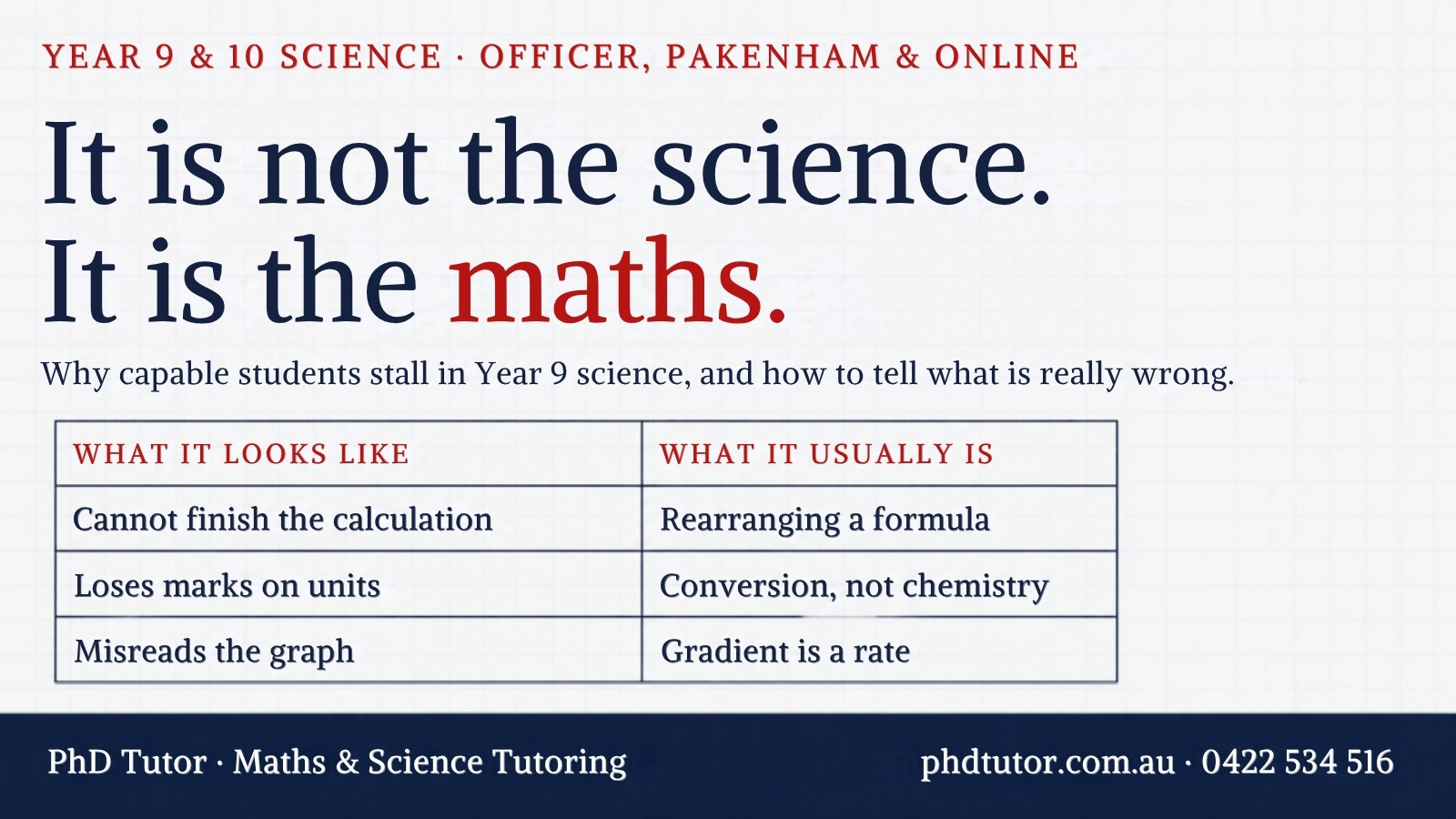
A parent in Officer said this to me last term, and I hear a version of it three or four times a year: “She was always good at science. Year 9 started and it fell apart. Now she says she just doesn’t get it any more.”
Almost every time, science isn’t the problem.
What actually changes in Year 9
Science up to Year 8 is mostly descriptive. Students learn what a cell does, why we have seasons, how a circuit works. They answer in sentences. A student with a good memory and real curiosity does well.
From Year 9 the same topics turn quantitative. Not harder to understand, harder to calculate. The concepts are often ones they already met, now carrying a formula, a set of units and an expectation that they can manipulate both.
Here is what that looks like in practice:
- Rearranging formulas. They are given speed = distance / time and asked for the time. That is an algebra step, not a physics step.
- Units and conversions. Millilitres to cubic centimetres, grams to kilograms, minutes to seconds. Marks are lost here constantly, and never because the student misunderstood the science.
- Scientific notation. Suddenly 0.00045 has to be written as 4.5 by ten to the negative four, and multiplied by something else in the same form.
- Graphs as information. Not just plotting points, but reading a gradient and knowing the gradient is the rate.
- Proportional reasoning. Concentration, dilution, ratios in genetics, scaling in energy calculations.
Every one of those is a mathematics skill wearing a lab coat.
Why it gets diagnosed as “bad at science”
Here is the sequence. The student understands the concept in class. They get the worksheet home. They cannot rearrange the formula, so they cannot finish the question. They get it back marked wrong. They conclude they do not understand electricity, or chemical reactions, or forces.
They do. They cannot do the algebra under time pressure, which is a different problem with a different fix.
It compounds, because science and maths are usually taught by different teachers who are each seeing half the picture. The science teacher sees a student who cannot do the calculations and assumes weak science. The maths teacher sees a student who is coping with Year 9 algebra in isolation and sees no issue.
How to tell which one it is
There is a simple test you can run at the kitchen table. Take a question they got wrong and ask them to explain, in words, what is going on. No numbers.
If they can tell you that a heavier object needs more force to accelerate at the same rate, or that adding water to a solution lowers the concentration, the science is intact. What failed was the arithmetic or the algebra underneath it.
If they cannot explain it in words either, then it genuinely is the science, and that is worth knowing too.
What actually helps
If it is the maths, more science revision will not fix it. The student will re-read the chapter, understand it again, sit the test and lose the same marks in the same place.
What works is unglamorous: fix the algebra, with science questions as the practice material. Rearranging formulas until it is automatic. Units until conversions stop being a guess. Scientific notation until it is boring. Reading gradients off graphs until the student sees a rate rather than a line.
Done properly this takes a term, not a year, and it lifts both subjects at once, because the same gap was quietly costing marks in maths as well.
Why this matters more at VCE
It stops being a Year 9 annoyance and becomes a serious constraint at VCE.
VCE Physics is substantially a mathematics subject. Chemistry involves constant quantitative work with moles, concentrations and stoichiometry. Both are far more comfortable for a student also doing Mathematical Methods, and genuinely difficult without that level of algebraic fluency.
A student who spent Years 9 and 10 believing they were bad at science frequently rules out Physics and Chemistry at subject selection. That closes the door on engineering, most health sciences and a good deal of the university system, on the basis of a problem that was never really about science.
That is the part worth catching early.
Is it the science or the maths? I teach maths and science together, which means I can usually tell within a session. I work with students in Officer, Pakenham, Beaconsfield and Berwick, and online across Victoria, one-to-one or in small classes capped at three.
I am a PhD researcher at Swinburne University of Technology, where I also teach mathematics to engineering undergraduates. First assessment session is free. Call or text 0422 534 516.

Related Posts
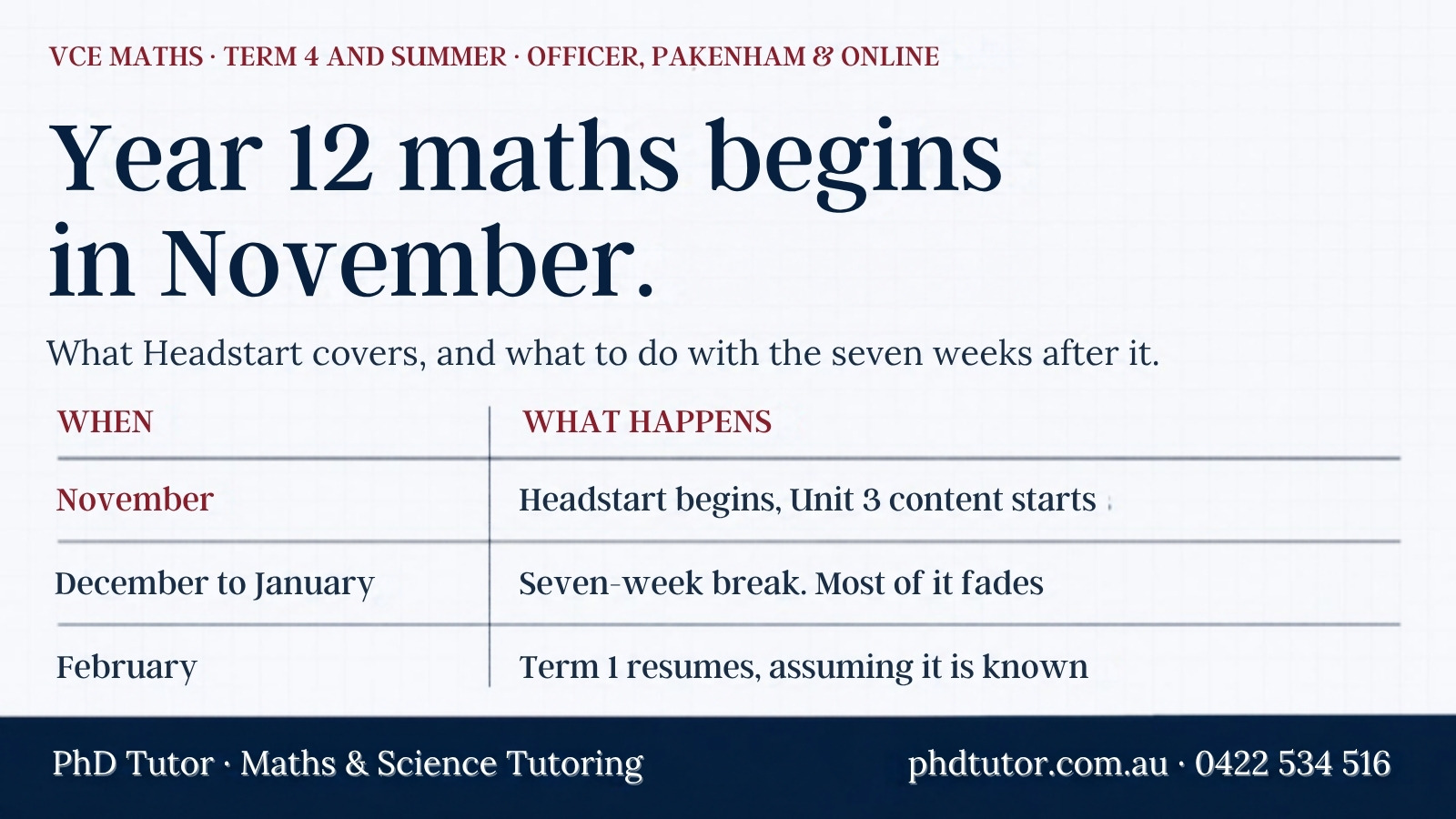
Headstart: why Year 12 maths really begins in November
Victorian schools start Unit 3 content in Term 4, then students break for seven weeks and Term 1 assumes they remember it. What to actually do over summer, and what not to bother with.
Read More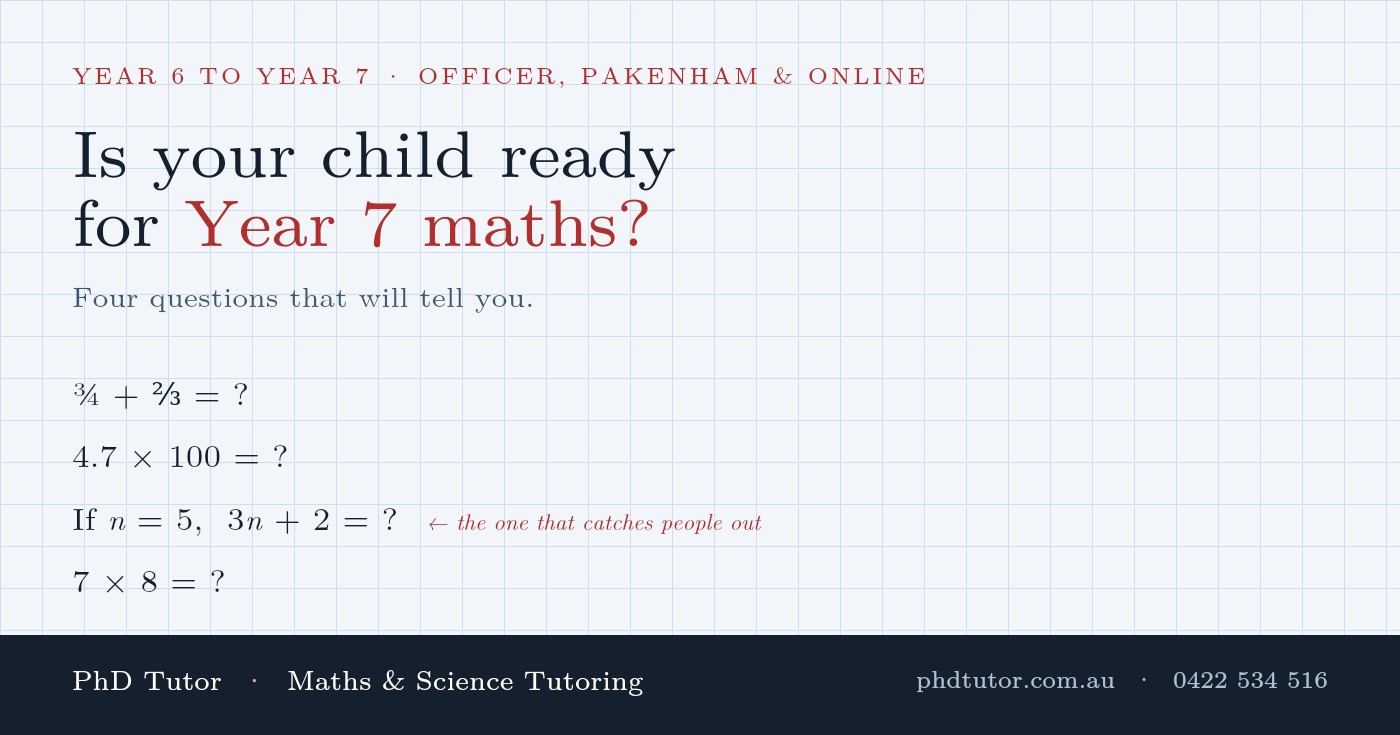
Is your child ready for Year 7 maths?
Officer has seven primary schools and one government secondary college. Pakenham has a good many more. Which means that every December, a few hundred local…
Read More
)
Is your child ready for Year 7 maths? – Maths & Science Tutor Officer & Pakenham | PhD Tutor
October 2, 2026[…] October 2, 2026 […]