
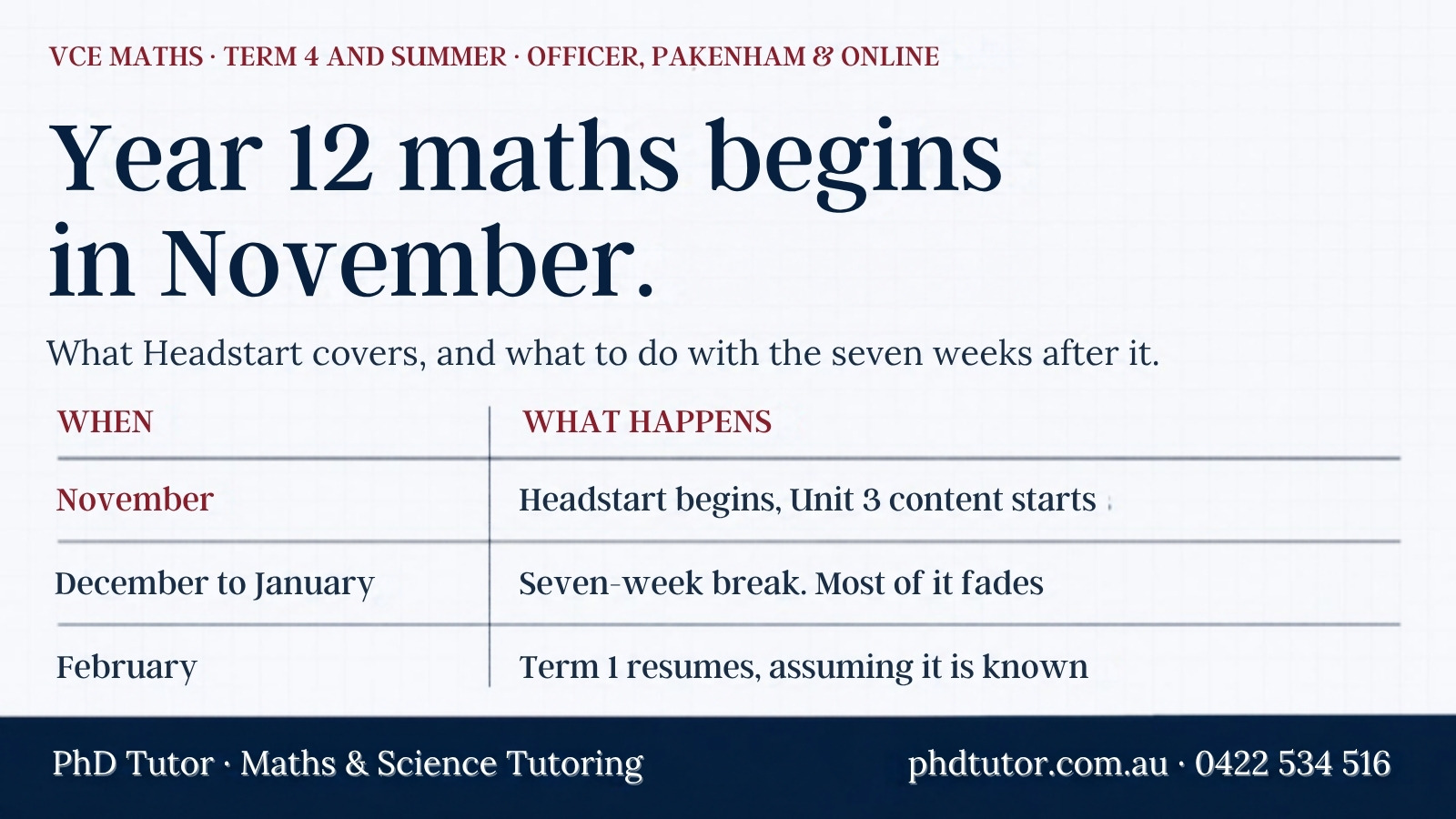
Most parents think Year 12 starts in February. In Victoria it starts in November.
Most schools run a Headstart or Transition program in the last few weeks of Term 4, where students finish Units 1 and 2 and begin Unit 3 content straight away. By the time the school year ends in December, a Year 11 student has usually already met the first chapter of their Year 12 maths course.
Then they put it down for six or seven weeks.
Why that gap causes trouble
Headstart is taught quickly. It is a few weeks, often with a different timetable, frequently with the class still mentally in the previous year. Students meet the material but rarely consolidate it.
In Mathematical Methods, the first area of study is functions, relations and graphs: transformations, domain and range, inverse functions, composite functions. It is foundational. Nearly everything in Unit 3 and 4 builds on being fluent with it.
What then happens is that the long break erases most of it, and Term 1 does not re-teach it. The class moves on assuming it is known. Four weeks into February a student who was coping in November is now behind, and the first SAC arrives before anyone has noticed.
This is the single most common way a capable student loses ground in Year 12, and it is almost entirely avoidable.
What actually works over summer
Not what most people picture. “Getting ahead” by racing through the textbook is a poor use of the holidays and usually collapses by the second week.
What works is consolidation, in small amounts:
- Two to three hours a week. Not a day. Spread across two sittings, not one long one.
- Only the Headstart material. Whatever chapter the school covered in November, and nothing beyond it. The goal is that it is automatic in February, not that they have seen Chapter 6.
- Problems, not reading. Re-reading notes produces a feeling of understanding that does not survive contact with a question.
- Calculator fluency. Summer is the ideal time to get genuinely quick on the CAS, because it is pure practice and needs no new theory.
- Leave several weeks completely free. Deliberately. A rested student in February beats an exhausted one.
That is roughly twenty to thirty hours across a summer. It is not a sacrifice of the holidays, and it reliably buys back a month of Term 1.
What does not work
Buying a Year 12 textbook in December and expecting it to be opened. Working through past exams before the content is learned, which teaches nothing except that the exam is hard. Booking an intensive week in late January, which is cramming with better marketing.
And starting Specialist Mathematics content over summer when the student is not yet solid in Methods. Specialist is taken alongside Methods 3 and 4 for a reason, and the Methods fluency has to come first.
If your child is doing General Maths
The same pattern applies, though the stakes are lower. General Mathematics Units 3 and 4, which replaced Further Mathematics in the current study design, is a more forgiving course, and the data analysis material at the start is self-contained enough to pick back up. If the subject choice itself is still open, I have written separately about choosing between Methods, Specialist and General.
Light consolidation is still worth it. An hour a week is plenty.
One honest caveat
Some students should do nothing at all over summer.
If Year 11 ended with a student who is burnt out, anxious about maths, or who has been pushed hard for two years, more maths in January is the wrong prescription. A proper rest will do more for their Year 12 than twenty hours of consolidation. The signs are usually obvious to a parent: avoidance, tears over homework, a flat response to a subject they used to be fine with.
For everyone else, the few weeks after Headstart are the cheapest marks available in the whole of Year 12, because almost nobody uses them.
Planning Year 12 maths? I run Methods, Specialist and General tutoring in Officer, Pakenham, Beaconsfield and Berwick, and online across Victoria. One-to-one, or small classes capped at three students.
I am a PhD researcher at Swinburne University of Technology, where I teach calculus, algebra and statistics to engineering undergraduates. First assessment session is free. Call or text 0422 534 516.

Related Posts
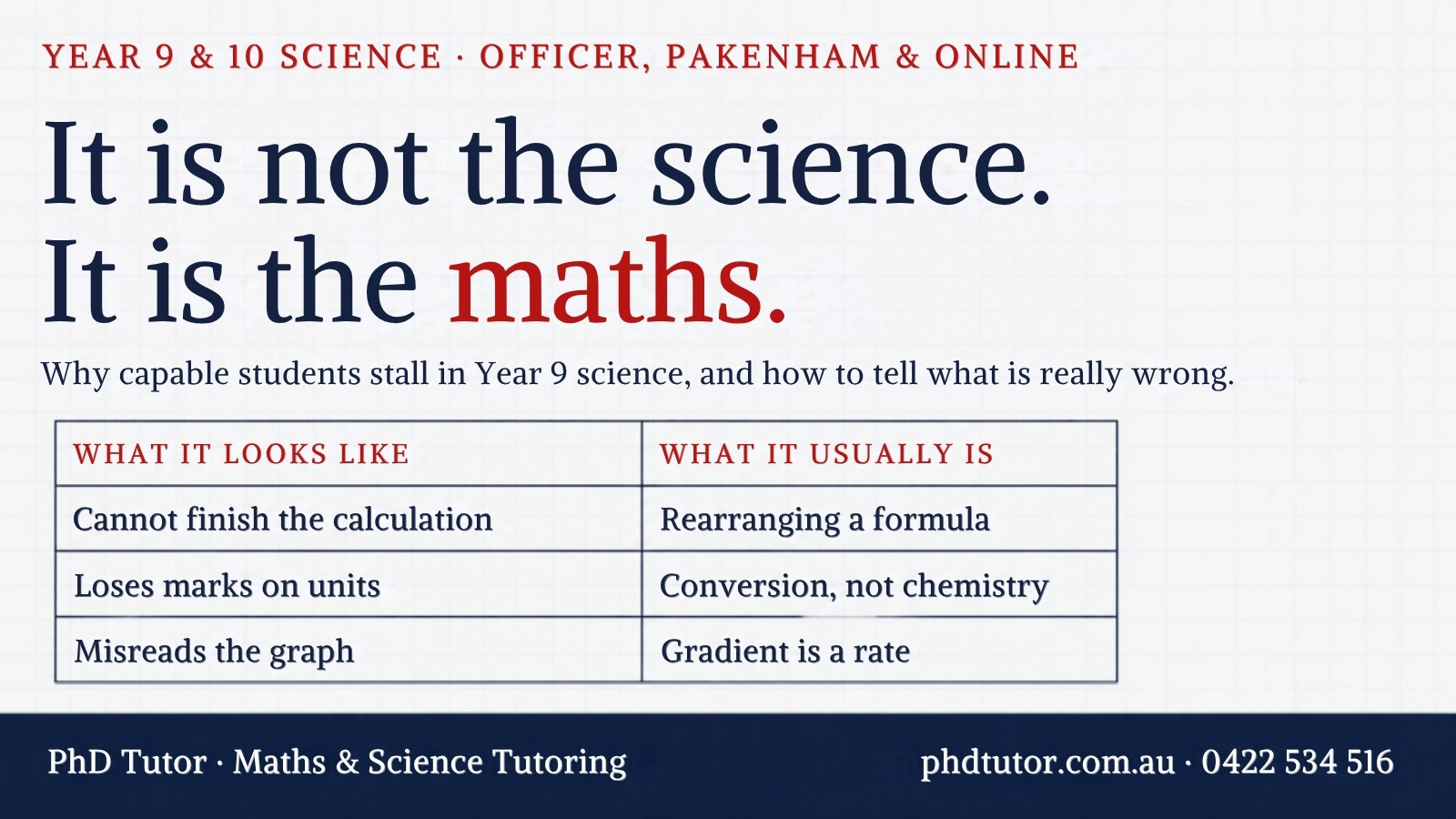
Why Year 9 science suddenly gets harder (and why it is usually maths)
Parents often tell me their child was fine at science until Year 9. Usually the science is intact and the algebra underneath it is not. How to tell the difference, and what to do about it.
Read More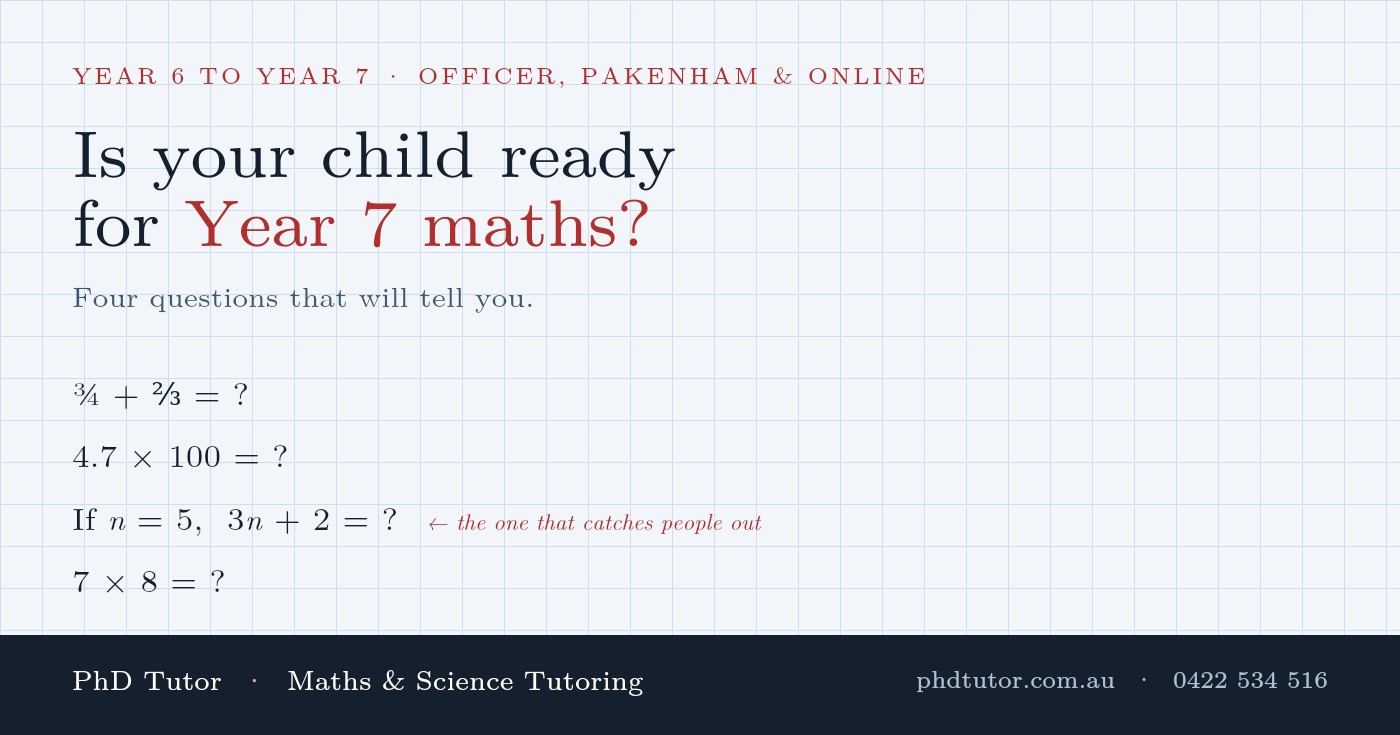
Is your child ready for Year 7 maths?
Officer has seven primary schools and one government secondary college. Pakenham has a good many more. Which means that every December, a few hundred local…
Read More

Methods, Specialist or General: choosing VCE maths – Maths & Science Tutor Officer & Pakenham | PhD Tutor
October 2, 2026[…] is solid, and it isn’t — and Unit 3 content starts earlier than most families expect, in November, during Headstart. Most Year 12 Methods struggle traces back to Year […]