Officer has seven primary schools and one government secondary college. Pakenham has a good many more. Which means that every December, a few hundred local children finish Year 6 confident in maths, and by about March a noticeable share of them have stopped feeling that way.
It isn’t that high school maths is harder in some general sense. It’s that it asks for something different, and it assumes three specific things are already solid.
What changes between Year 6 and Year 7
Primary maths is mostly about doing. Work out the answer, check it, move on.
Secondary maths is about generalising. Instead of finding what three times four is, you’re asked what happens when you multiply any two numbers of a certain kind — and to write that as a rule using letters.
That’s a real shift in thinking, and it happens fast. By the end of Term 1, most Year 7 students have met algebraic notation, negative numbers and the beginnings of formal proof-style reasoning.
Students who arrive with the groundwork solid find it interesting. Students who arrive shaky find it bewildering, and the curriculum doesn’t stop for them.
The three things Year 7 assumes
Fractions. Not just recognising a half, but adding, subtracting, multiplying and dividing them, and converting between fractions, decimals and percentages fluently. Fractions are where more secondary maths problems originate than any other single topic. Algebra is essentially fractions with letters in, and a student who guesses at fractions will guess at algebra.
Decimals and place value. Including multiplying and dividing by ten, a hundred and a thousand without a calculator, and knowing where the decimal point goes and why. Secondary science leans on this too — unit conversions in Year 8 chemistry catch out students whose place value is loose.
Early algebra. Understanding that a letter stands for a number, that 3n means three lots of n, and being able to substitute a value into a simple expression. Many primary schools introduce this and many students never quite absorb it.
There’s a fourth thing that isn’t a topic: times tables. A student who has to calculate seven eights is spending working memory on arithmetic that should be automatic. That memory is needed for the actual problem. It’s the least glamorous thing on this list and it makes more difference than any of them.
How to check without making it a thing
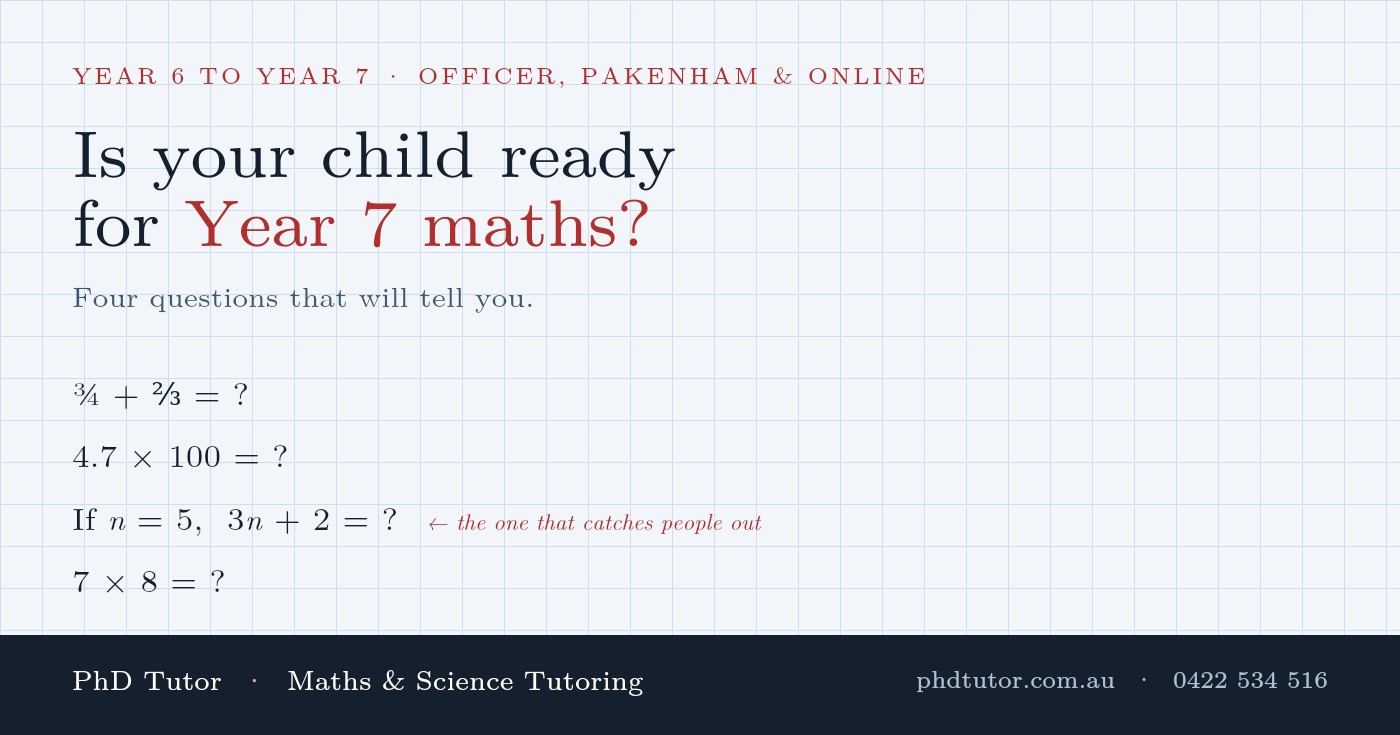
You don’t need a test. Ask your child to talk you through four questions over a week, casually:
- What is three quarters plus two thirds?
- What is 4.7 multiplied by 100?
- If n is 5, what is 3n plus 2?
- What is seven times eight?
You’re not looking for correct answers so much as how they get there. A child who answers quickly and confidently is fine. A child who works it out slowly but correctly is also fine. A child who freezes, guesses, or reaches for a calculator on the last one has found you the gap.
That’s useful information, not bad news. A gap found in October is a holiday project. The same gap found in Year 9 is three years of compounding to unpick.
What to do if something’s shaky
Don’t drill. More of the same work that didn’t land the first time rarely lands the second.
Go back further than feels necessary. If fractions are shaky, check that the student understands what a fraction is — a division, a part of a whole, a point on a number line — before practising operations on them. Most fraction difficulty is conceptual, not procedural.
Use the summer. Six weeks between Year 6 and Year 7 is enough to repair any of these, without competing against homework. Twenty minutes a few times a week is plenty. It doesn’t need to eat the holidays.
Keep it low-stakes. A child who believes they’re bad at maths will underperform regardless of what they know. The belief does more damage than the gap, and it’s harder to shift.
If selective entry is on your mind
For some families the Year 6 to 7 move comes with a second question: whether to aim at Nossal High School in Berwick, or a scholarship place at one of the independent schools.
Year 7 is the right time to be thinking about it, because the Victorian selective entry exam is sat in the middle of Year 8, for entry into Year 9. That leaves about a year — which sounds like plenty and isn’t, once you know what the exam tests.
It isn’t a maths and English test. It measures reasoning under severe time pressure: number patterns with rules nobody explains, passages where the answer is implied rather than stated, and questions that are straightforward once you see the shortcut and nearly impossible in the time allowed if you don’t.
None of that appears on a school report, which is why capable students routinely underperform on a first attempt. Their school has never asked them to work this way.
The connection to everything above is direct. A student whose fractions and times tables aren’t automatic will lose the quantitative reasoning section on speed alone, regardless of how bright they are. The foundations that make Year 7 comfortable are the same ones that make the exam survivable.
So if selective entry is a possibility, the groundwork this post describes isn’t separate preparation. It’s the first part of it.
A free readiness check
I’ve put together a one-page Year 6 maths readiness check covering these areas. It takes about twenty minutes, and it tells you whether fractions, decimals and early algebra are actually solid.
It’s free, there’s no obligation, and you don’t need to book anything to get it. Text me on 0422 534 516 or email help@phdtutor.com.au and I’ll send it over.
If it turns up something, we can talk about it. If it doesn’t, you’ve spent twenty minutes and can stop worrying — which is a perfectly good outcome.
If you’d like help
I tutor maths and science from Prep through to VCE, across Officer, Pakenham, Beaconsfield, Berwick, Clyde North and Narre Warren, or online across Victoria. That includes selective school and scholarship exam preparation — numerical reasoning, general ability, and full mock papers under timed conditions.
Year 6 to Year 7 transition work is some of the most useful tutoring there is, because it’s preventative. Repairing a fraction gap in December takes a handful of sessions. The same gap surfacing as an algebra problem in Year 9 takes considerably longer, and by then the student has spent three years believing they’re not a maths person.
Every student starts with a free thirty-minute assessment, before any teaching. One-to-one, or small classes capped at three students.
I’m Komal, a PhD researcher at Swinburne University of Technology, where I teach mathematics to engineering undergraduates. I teach every session myself.
Rated 5.0 ⭐⭐⭐⭐⭐ from Google reviews. You can read them here.
Call or text 0422 534 516, or visit phdtutor.com.au.