Every August, Year 10 students across Officer, Pakenham, Beaconsfield and Berwick sit down with a subject selection form and make a decision that shapes the next two years. Most of them make it with about twenty minutes of thought and whatever their friends are doing.
It deserves more than that. Not because the wrong choice is a disaster — it usually isn’t — but because the right choice makes Year 11 and 12 considerably less painful.
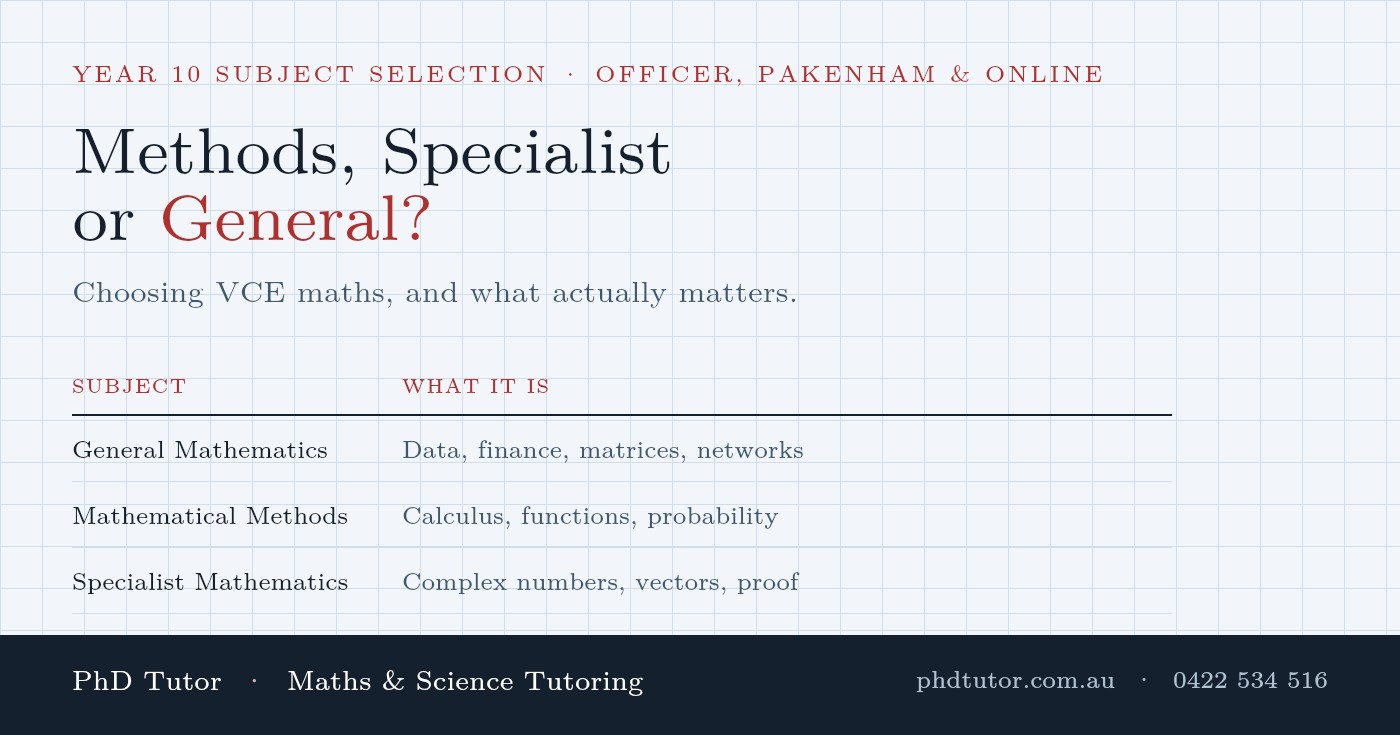
Here’s how the three VCE maths subjects actually differ, and how to think about which fits.
The three subjects
VCE General Mathematics covers data analysis, recursion and financial modelling, matrices, and networks and decision mathematics. It’s practical, heavily calculator-based, and the mathematics is applied rather than abstract.
VCE Mathematical Methods is the calculus subject. Functions and graphs, differentiation and integration, and probability and statistics. It’s the prerequisite for most science, engineering, commerce and health degrees, which is why it’s the most commonly taken.
VCE Specialist Mathematics is the extension subject. Complex numbers, vectors, kinematics and mechanics, differential equations, and formal proof. It must be taken alongside Methods, not instead of it, and it’s genuinely difficult.
Start with where they’re going, not what they’re good at
The most useful question isn’t “which maths is my child best at?” It’s “what do the courses they might want actually require?”
Mathematical Methods is a prerequisite for most engineering, science, computer science, physiotherapy, pharmacy and many commerce degrees. Some medicine pathways require it. If there’s any chance of one of these, Methods needs to be on the form.
Specialist Mathematics is a prerequisite for very few courses — some engineering and mathematics degrees list it, most don’t. Its value is different, and I’ll come to that.
General Mathematics satisfies the maths requirement for arts, education, nursing in some institutions, business and most humanities pathways.
The mistake families make is choosing on current comfort and closing a door they didn’t know was there. A Year 10 student who isn’t sure what they want should keep Methods open if they can, because dropping it in Year 11 is easy and adding it back isn’t.
Scaling, and what it really means
VCE scaling gets discussed a lot in Officer and Pakenham families, usually inaccurately.
Specialist Mathematics scales up substantially. Methods scales up moderately. General Mathematics scales down slightly.
But scaling adjusts for the strength of the cohort taking a subject — it doesn’t reward you for picking a hard subject. A student who scores 25 in Specialist ends up worse off than one who scores 40 in General. Scaling helps students who do well in a hard subject. It doesn’t rescue students who struggle in one.
Choose the subject your child can do well in. Then let scaling do what it does.
The workload nobody mentions
Specialist plus Methods together is a serious load. Two maths subjects, both with SACs, both with substantial homework, both examined heavily.
Students who take both and also carry Physics and Chemistry are doing four quantitative subjects at once. Some thrive on it. Others spend Year 12 exhausted and do worse across every subject than they would have with a lighter combination.
Be honest about your child’s capacity and about what else they’re carrying — sport, work, family, mental health. The strongest ATAR usually comes from a combination a student can sustain, not the hardest one they can survive.
Where students actually come unstuck
In my experience tutoring VCE maths across Officer, Pakenham, Beaconsfield and Berwick, the problems are predictable.
Methods Units 1 and 2 are underestimated. Students treat first year as a warm-up and coast. Units 3 and 4 then assume every bit of that groundwork is solid, and it isn’t. Most Year 12 Methods struggle traces back to Year 11.
Specialist is taught in small classes, sometimes thinly. Local secondary schools often run Specialist with six or eight students and a teacher covering several subjects. That’s not a criticism of the schools — it’s a staffing reality in a growth corridor — but it means Specialist students frequently need more support than Methods students do.
General Mathematics gets treated as the easy option. It isn’t. The exams reward accuracy and speed rather than insight, and marks are lost to careless work far more often than to not understanding. It’s also the most CAS-dependent of the three: a student quick with their calculator finishes the exam, and one who isn’t, doesn’t.
Nobody practises under time. Across all three subjects, the single biggest source of lost marks is questions never reached. Knowing the content and finishing the paper are different skills.
A rough guide
Take Specialist if your child genuinely enjoys mathematics, is comfortably strong in Year 10 maths, and is heading toward engineering, mathematics or physics. Not because it scales.
Take Methods if there’s any chance of a science, engineering, commerce or health pathway — or if you’re simply unsure. It keeps the most doors open.
Take General if your child’s strengths and interests are elsewhere and the courses they’re considering don’t require Methods. A strong General result beats a mediocre Methods one, on the ATAR and on their confidence.
Take Methods and General together if they want the prerequisite but want a safety net. It’s a common and sensible combination.
Talk to the school first
Your child’s Year 10 maths teacher has seen them work all year and knows the Year 11 teaching staff. That’s information no blog post can give you.
Ask two questions: is my child ready for Methods Units 1 and 2, and what does the school’s Specialist class look like next year?
The second one matters more than families expect.
If they need support
I tutor VCE Mathematical Methods, Specialist Mathematics and General Mathematics through Units 1 to 4, alongside VCE Physics and Chemistry — and IB Mathematics, which almost nobody in this corridor offers.
Sessions cover content, SAC preparation, past papers worked under timed conditions, CAS calculator technique, and building a bound reference that’s actually usable in an exam rather than just thick.
I’m a PhD researcher at Swinburne University of Technology, where I teach calculus, algebra, statistics and R to engineering undergraduates — the mathematics all three of these subjects lead into. When a student asks why a rule works, they get the real reason, which is usually what makes it stick.
One-to-one, or small classes capped at three students. In person in Officer, Pakenham, Beaconsfield, Berwick, Clyde North and Narre Warren, or online across Victoria.
Rated 5.0 ⭐from Google reviews. You can read them here.
First assessment session is free. Call or text 0422 534 516.


Related Posts
High School Maths Tutor in Beaconsfield: Personalized Learning for Success
Most Beaconsfield students go on to St Francis Xavier College, and a lot of them hit the same wall at the same time: somewhere in…
Read More