Almost every parent who asks me about Nossal starts from the same assumption: that it’s a hard maths and English test, and a student who does well at school should do well on it.
That assumption is why bright students underperform on their first attempt.
It isn’t a Nossal exam
The first thing worth knowing is that Nossal doesn’t set its own test. There is one Victorian Selective Entry High School exam, and it covers all four schools — Melbourne High, Mac.Robertson Girls’, Suzanne Cory and Nossal. Every applicant sits the same paper on the same day and lists their school preferences on the application.
So when you search for “Nossal entrance exam preparation,” what you’re actually preparing for is the SEHS exam. Anything written for Melbourne High applies to your child equally.
It’s sat in the middle of Year 8, for entry into Year 9 the following year. Roughly a thousand places are offered against somewhere between five and six thousand applicants.
What’s actually on the paper
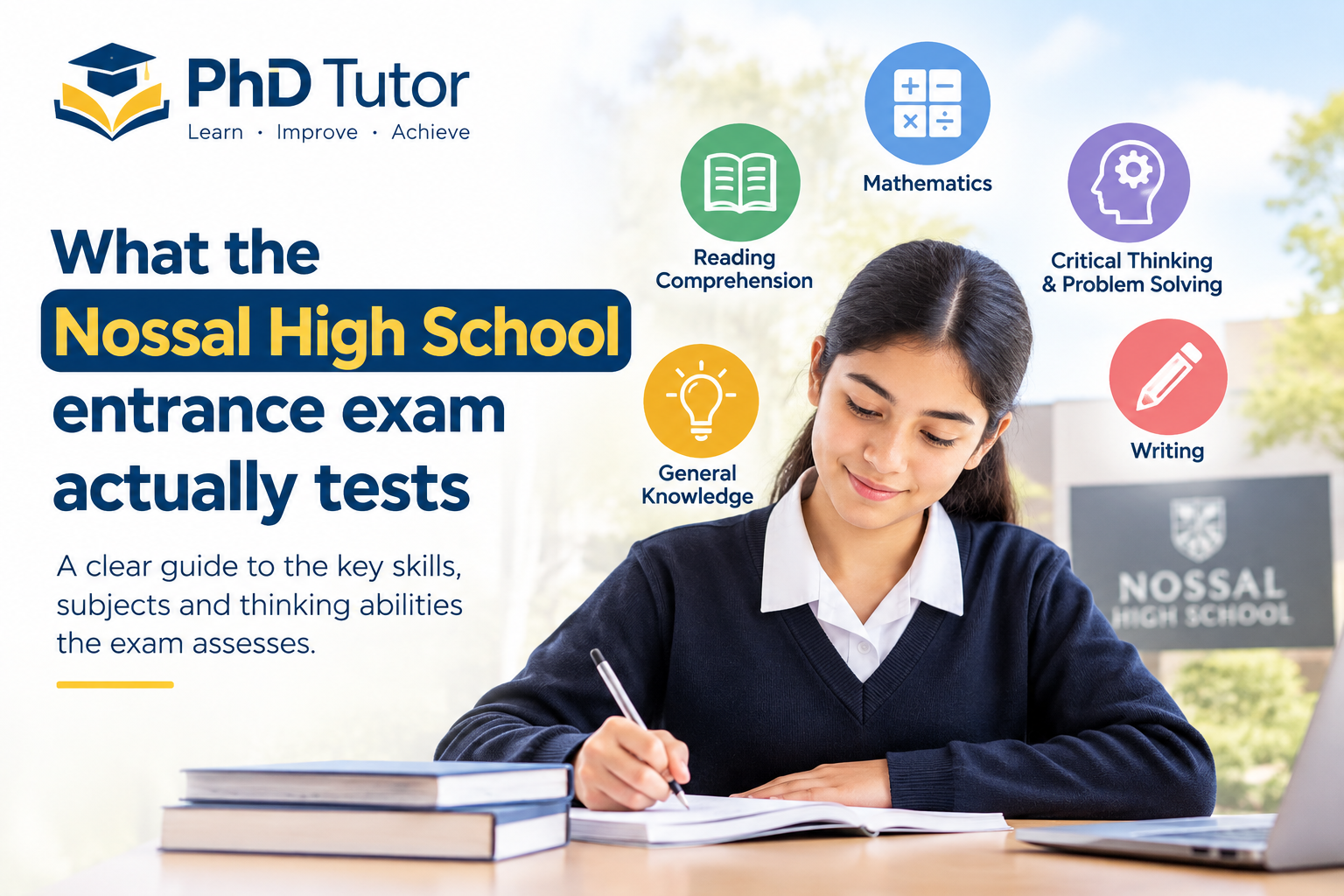
According to Nossal’s own website, the exam runs about three hours and is made up of five components:
- Reasoning — Reading (35 minutes)
- Reasoning — Mathematics (30 minutes)
- Break — 20 minutes
- General Ability — Verbal (30 minutes)
- General Ability — Quantitative (30 minutes)
- Break — 5 minutes
- Writing (40 minutes)
Two things about it surprise most families.
Calculators aren’t permitted. Students who have grown up doing arithmetic on a device find the mental-maths demand harder than the mathematics itself.
The timing is severe. Half an hour per section, with a lot of questions in each. Working accurately isn’t enough — students need to work accurately and fast, and most have never been asked to do both at once.
One detail worth knowing, because it settles a lot of nerves: before each section begins, the administrator goes through practice examples with the whole room, and students can ask questions if they’re unsure what a task requires. Your child won’t be handed an unfamiliar question type cold.
Nossal enrols 208 students into Year 9 each year. Exam dates and application windows are announced at the end of February, so check nossalhs.vic.edu.au for the current cycle.
The part that catches people out
Here is the thing that matters most, and it’s why school performance is a poor predictor.
The exam is not testing the Year 8 curriculum. It’s testing reasoning.
A curriculum test asks whether your child has learnt what they were taught. A reasoning test asks whether they can work out something they have never seen before, quickly, under pressure.
In practice that means questions like:
- A number sequence following a rule nobody explains, where the task is to find the rule
- A short passage where the answer is implied rather than stated
- A word relationship problem where the pattern must be inferred from a single example
- A mathematics question that is straightforward once you see the shortcut, and nearly impossible in the time allowed if you don’t
None of this appears on a school report. A student can be top of their Year 8 maths class and still find the quantitative reasoning section unfamiliar, because school has never asked them to work this way.
That’s not a failing in your child or their school. It’s a different skill — and it’s an entirely learnable one.
What preparation actually involves
Because it’s a reasoning test, preparation looks different from ordinary tutoring.
Learning the question types. There are recurring formats, and a student who recognises a question type from the first line saves fifteen seconds. Across a whole section that’s the difference between finishing and not finishing.
Building speed deliberately. Not by rushing, but by removing hesitation. Most lost marks in this exam come from questions never reached, not questions answered wrongly.
Sitting full papers under real conditions. Timed, no calculator, no breaks, no help. The first full paper a student sits is usually a shock, and it’s much better that it happens in a practice session than in June.
Reviewing the questions they got right by guessing. This is the one most preparation skips. A correct guess looks the same as understanding on a score sheet, and it is the thing that fails you when the real paper varies slightly.
Reading widely. The verbal reasoning and comprehension sections reward vocabulary that can’t be crammed. Half an hour of daily reading over a year beats any amount of last-minute work.
When to start
Preparation is best begun about a year out — Year 7 Term 4 or early Year 8.
Students who start six weeks before the exam can still improve, but they’re learning the format and building the reasoning at the same time, and there isn’t enough time to do both properly.
Starting earlier isn’t about more hours. It’s about the reasoning becoming familiar rather than something being crammed.
One honest thing about the odds
With roughly a thousand places and five to six thousand candidates, most students who sit this exam won’t receive an offer. That is worth saying plainly at the start rather than discovering in September.
But the preparation is not wasted, and I’d say that even to families who don’t get in. The reasoning skills, the reading habit and the ability to work accurately under time pressure carry directly into VCE. Students who prepare seriously for this exam are usually stronger in Year 9 regardless of where they end up.
Go in wanting the place. Don’t stake your child’s confidence on it.
Preparing for the Victorian selective entry exam? I tutor students in Officer and Pakenham and online across Victoria, covering numerical reasoning, general ability and full mock papers under timed conditions. First assessment session is free — call or text 0422 534 516.