The Cardinia and Casey growth corridor has changed fast. Officer had a few thousand people a decade ago and now has eighteen thousand. Pakenham has grown past fifty thousand. New primary schools have opened in Officer almost yearly — Bridgewood, Kurrun, Kurmile, Orchard Park — and Officer Secondary College went from nothing to a thousand students.
What hasn’t kept pace is support for the families in them. Class sizes are large, teachers are stretched, and a student who falls behind in maths or science can go a long way before anyone notices.
Here’s what that looks like suburb by suburb, and what I’d suggest for each.
Officer
Officer is primary-heavy. Seven Prep-to-Year-6 schools and one government secondary, which means the Year 6 to Year 7 transition matters more here than almost anywhere.
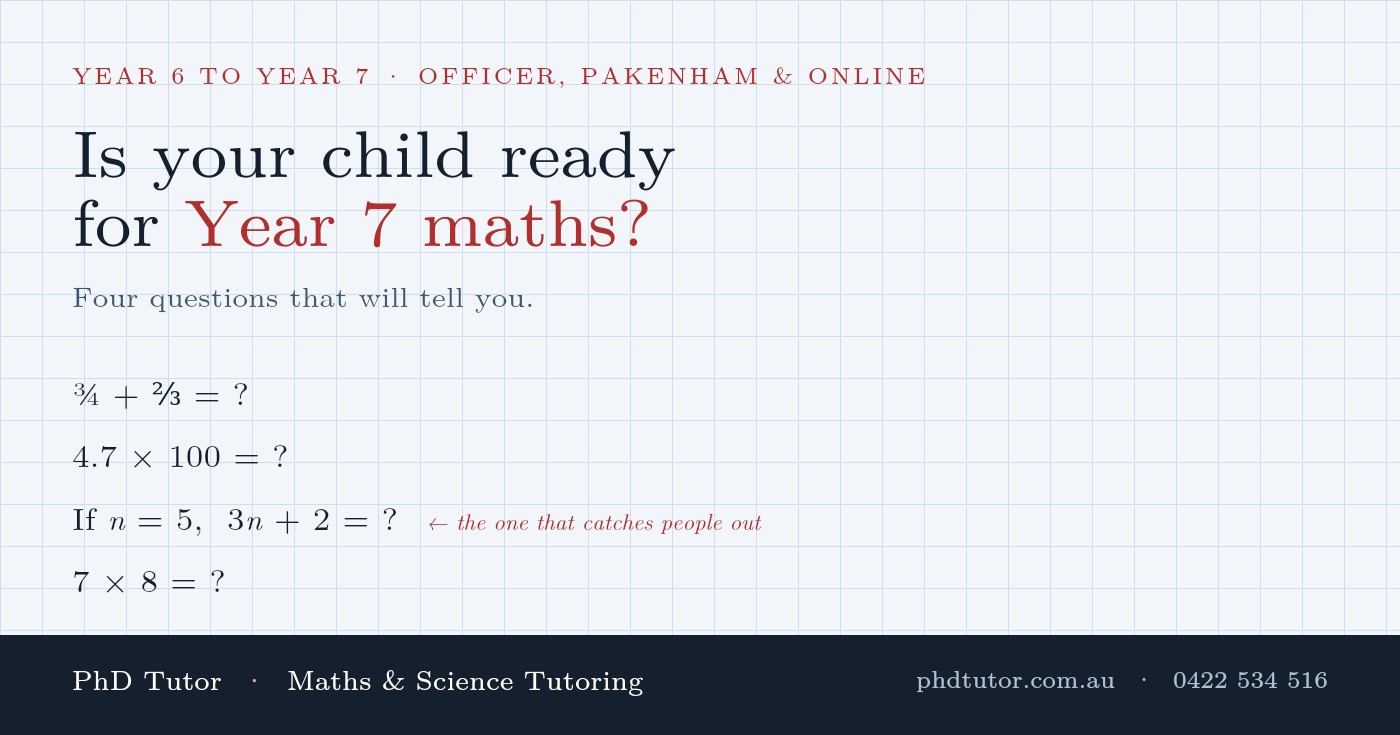
Students arrive at high school assuming the maths will feel like Year 6 with harder numbers. It doesn’t. Secondary maths asks you to generalise — to move from a specific answer to a rule covering every case — and the curriculum doesn’t slow down for anyone still catching up.
The three things worth checking before Year 7 are fractions, decimals and simple algebra. Those are what high school assumes on day one.
Science matters here too, and it’s often overlooked. Primary science is mostly observation; secondary science turns into measurement, ratios and rearranging equations. Students who find Year 8 science hard are frequently stuck on the maths inside it rather than the science itself.
I teach from Officer, so in-person sessions here are straightforward.
Pakenham
Pakenham is bigger and older than Officer, with a wider spread of schools and a longer-established community. The families I see from Pakenham are often further along — Year 9, Year 10, VCE — and the issue is usually less about a single gap and more about a subject that got away over a couple of years.
That takes longer to repair and it’s entirely repairable, but it’s worth starting before Year 11 rather than during it. The same applies to science — a student shaky on Year 9 chemistry calculations will struggle with VCE Chemistry, and the fix is usually mathematical.
Pakenham is a short drive from Officer, and plenty of families here choose online sessions instead to skip the travel altogether.
Beaconsfield
Most Beaconsfield students head to St Francis Xavier College, and a lot of them meet the same wall in Year 8 or 9 — the point where maths stops being something you can keep up with by paying attention in class.
It’s rarely a sudden drop. It’s a gap from a year or two earlier that has been quietly compounding. Junior science tends to slip at the same time, for the same reason.
Beaconsfield sits between Officer and Berwick, so it’s close either way.
Berwick
Berwick has Nossal High School, and that shapes what families here ask about. Selective entry preparation comes up constantly — the exam is sat in Year 8 for Year 9 entry, and it tests reasoning rather than the school curriculum, which is why capable students underperform on a first attempt without preparation.
Berwick also has a concentration of families aiming at scholarship places in the independent schools, which is a related but different kind of preparation.
Clyde North and Narre Warren
Newer estates, younger families, and mostly primary-aged children. The questions I get here are about NAPLAN in Years 3 and 5, whether a child is where they should be, and how to keep an interest in science alive once school stops making it hands-on.
Both are reasonable things to want a straight answer on, and both are answerable in a single assessment session.
What’s the same everywhere
Across all of these suburbs, the pattern is the same.
The gap is rarely where it looks. A Year 9 student struggling with quadratics almost never has a quadratics problem. They have a Year 6 problem with fractions and three years of work built on top of it. Teaching more quadratics doesn’t help.
More practice doesn’t fix a missing foundation. You have to go back and lay it, which feels slower and isn’t.
Most students aren’t bad at maths or science. They’re missing something specific, and they’ve concluded from the resulting struggle that they can’t do it. Fixing the gap usually fixes the belief too.
Maths and science fail together. Physics is applied mathematics and chemistry runs on ratios and rearranged equations. A student whose algebra is shaky will find both harder than they should, and strengthening the maths often lifts the science without touching the science.
How sessions work
Every student starts with a free thirty-minute assessment, before any teaching. That’s how the actual gap gets found rather than guessed at.
After that, weekly sessions — one-to-one, or in small classes capped at three students.
That cap is worth dwelling on, because “small group” means nothing on its own. Every tutoring centre uses the phrase and it can describe a class of ten. In a small group of eight over an hour, a student gets about seven minutes of individual attention. In a small class of three, they get twenty. Ask any tutor for the number, not the adjective.
Students get worksheets between sessions and access to an online portal where they can practise, take tests and track their results. Parents can log in and see the same, so you know how your child is tracking without relying on their account of it.
In person: Officer, Pakenham, Beaconsfield, Berwick, Clyde North, Cardinia and Narre Warren.
Online: anywhere in Victoria, on a shared digital whiteboard. Popular with VCE students who’d rather not lose forty minutes to travel on a school night.
What I teach
Prep to Year 6 — English, mathematics and science, plus NAPLAN preparation for Years 3 and 5, and Year 6 to 7 readiness.
Years 7 to 10 — maths and science, plus selective school and scholarship exam preparation including Nossal High School.
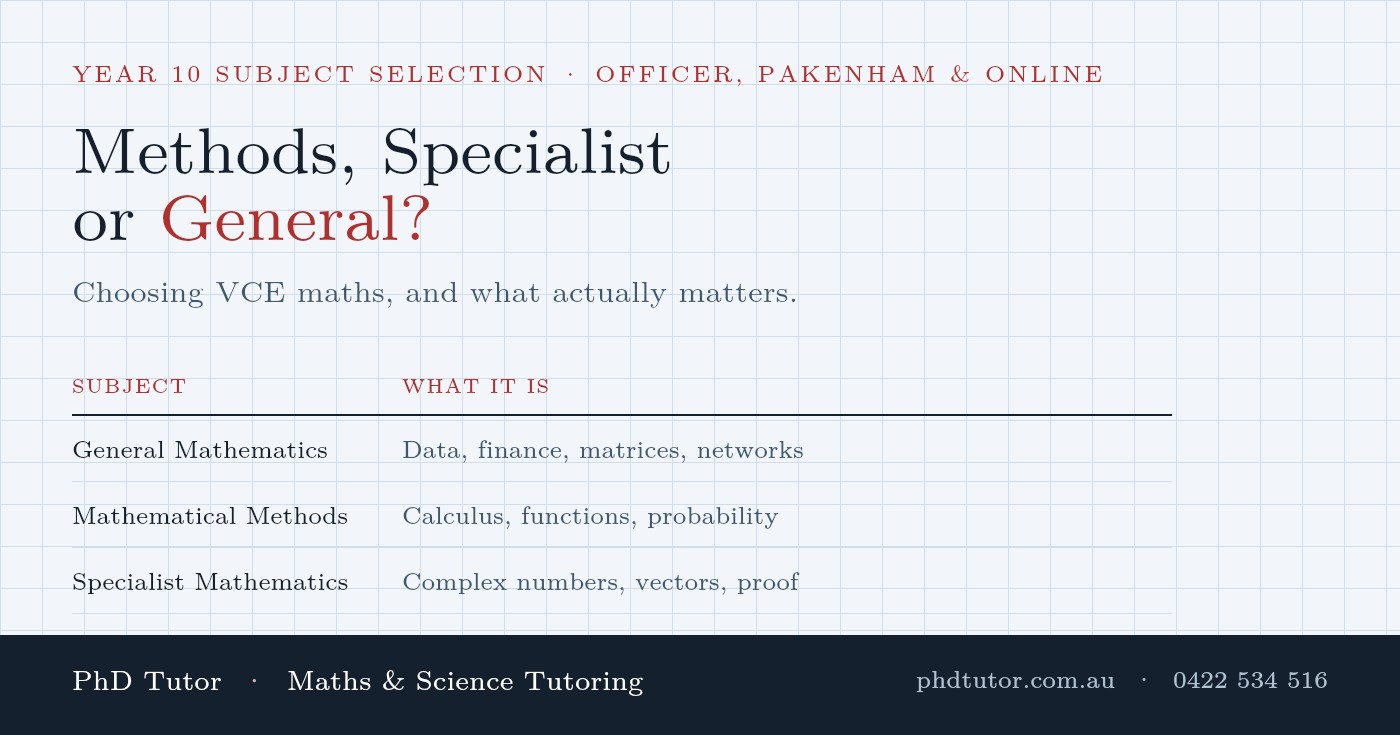
VCE — Mathematical Methods, Specialist Mathematics, General Mathematics, Physics and Chemistry through Units 1 to 4, with SAC preparation, past papers under timed conditions and CAS calculator work. Also IB Mathematics.
University level — calculus, linear algebra, statistics and differential equations for undergraduate and mature-age students.
Who’s teaching
I’m Komal. I’m a PhD researcher at Swinburne University of Technology, where I teach algebra, statistics, calculus and R to engineering undergraduates. My research in mathematical modelling has been published in a peer-reviewed journal.
I teach every session myself. There’s no roster of casual staff working through a franchise workbook — you’re getting the person you hired, every week.
Rated ⭐⭐⭐⭐⭐from Google reviews. You can read them here.
Working with Children Check held.
Starting
The first assessment session is free and there’s no obligation after it. It exists so you can see whether this is a fit, and so I can find out what’s going on before I start teaching.
Call or text 0422 534 516, or visit phdtutor.com.au.